%20--%3e%3cdefs%3e%3cstyle%3e%20.st0%20{%20fill:%20%232f3033;%20}%20%3c/style%3e%3c/defs%3e%3cpath%20class='st0'%20d='M602.4,56.4l3.5,3.6,7.4,8.1,3.1,3.3,5.5,6.1,5.3,5.5,4,4.2,3.6,3.8,7.5,8,4.1,4.3,2.2,2.5-3.6,3.3-8.5,7.4-3.1-3.3-5.4-6-9.8-10.5c-.5-.5-1-.9-1.7-.6-5.1,2.5-10.4,3.7-16,4.2h-7.1c-6.2-.4-12-2-17.5-4.8s-7.5-3.9-10.7-6.6c-3.8-3.2-7.1-6.7-9.7-10.9l-3.3-6c-3.2-5.9-4.6-12.2-5.1-18.9v-6.1c.6-7.4,2.6-14.3,6.1-20.8,2.4-4.5,5.2-8.4,8.9-12s5.2-4.9,8.4-6.6l6.2-3.3c5.7-2.5,11.6-3.9,17.8-4.4h5.4c9.6.7,16.7,2.3,24.9,7.5,6.3,4,11.8,9.1,15.7,15.4,8.7,14.3,10.9,30.7,4.7,46.3s-3.7,7.4-6,11.1l-6.1-5.6-3-3.3-3-3.2c2.5-4,3.9-8.3,4.6-12.9.9-5.7.2-11.3-1.7-16.8s-4.2-8.1-7.5-11.5c-5.6-5.8-13.1-9-21.1-10s-5.2-.2-7.9,0c-9,.8-17,5.1-22.7,12.1s-8.6,17.7-6.6,28.3c1.1,5.6,3.7,10.5,7.4,14.7l3.8,3.9c2.6,2.1,5.4,3.8,8.4,5.3,5.9,2.8,14.7,4,21.2,1.7l-3.8-4.3-6.4-6.6-4.9-5.6,6.3-5.5,5.8-4.7Z'/%3e%3cpath%20class='st0'%20d='M197.5,96.7c-2.9,1.1-5.8,2.4-9,2.4h-61.5s-3-.2-3-.2l-.3-2.3v-8c-.1,0-.2-5.8-.2-5.8h62.2c5.3,0,10.2-4,11.5-8.9s-2.5-12.7-9-14.3h-42.1s-4-.5-4-.5c-4.9-.6-9.2-2.8-13-5.7s-3-3-4.4-4.6c-5.2-6.2-7.2-14-6.1-21.9s3.6-12,8.3-16.6,9.8-7.3,15.8-7.6l5.1-.3h62.2c.1,1.3.1,2.3,0,3.5v2.4c0,0,.1,11.3.1,11.3h-57.1c0,0-8.4-.2-8.4-.2-4.5,0-9.3,4.8-9.7,10s.9,8.4,4.1,10.9c1.8,1.5,4.1,2.9,6.5,2.9h39c6.7,0,12.1,1.1,17.5,4.9s7.1,6.5,9.2,10.8,1.6,4.3,2.1,6.6c.9,4.5.6,9.1-.4,13.6-1.1,4.7-3.7,8.6-7.1,12-2.5,2.4-5,4.5-8.4,5.8Z'/%3e%3cpath%20class='st0'%20d='M505.2,51.2l-9.1-18.7-5.7-10.8-3.7,8.1-8.4,16.9-7.2,14.7-3.2,6.9-6.9,13.7-7.7,15.8c-.2.4-.7,1-1.1,1.4h-17.5s4.4-9.2,4.4-9.2l8.1-16.9,4-8.4,5.8-11.6,5.5-11.5,5-10.1,9-18.6,5.1-10.2h17.1c.2,0,.7-.3.9-.2s.5.5.7.8l6.1,12.6,6.6,14,5.2,11,6.3,12.7,10.6,22.1,3.5,7.4,7.8,16.1h-15.9s-2.5-.3-2.5-.3l-2.5-5-8-16h-33.6c0-.1-7.4-.3-7.4-.3l1.3-2.7,6.6-13.5h15c0,0,10.1-.2,10.1-.2l-4.4-9.9Z'/%3e%3cpath%20class='st0'%20d='M67.1,43.8l-10.7-21.8-8.4,16.8c-2.5,5.1-5.1,9.9-7.4,15l-6.1,12.1-8.9,18.2-3.7,8-3.2,6.1c-.2.5-1.1.9-1.7.9H4.1c0,0-4.1-.2-4.1-.2,1.7-3.1,3.1-6.3,4.6-9.4l.9-2,6.5-13c2.8-5.6,5.3-10.9,8.1-16.5l5.7-11.7,5-9.8,2.3-4.9,1.5-3.2,4.9-9.8c2.7-5.3,4.8-10.5,7.8-15.8l4.7-.2h13.6c1.4,2.4,2.5,4.9,3.8,7.5l9.8,20.8,7.4,15.3,4.5,9.8,7.5,15.2,4.6,10,6.6,13.7,2.1,4.2h-17.7c-1.5-2.3-2.6-4.4-3.7-6.8-2.2-5-4.6-9.8-7.2-14.7h-1.7s-33.9,0-33.9,0l-5.7-.4,7.3-14.2c.2-.5.6-1.7,1.1-1.8h8.5c3.5,0,6.9-.1,10.4,0h6.4c-1.9-3.6-3.3-6.8-5-10.3l-3.4-7.1Z'/%3e%3cpath%20class='st0'%20d='M393,88.9l-7.6-7.8-2.8-3.1-10.9-11.5-6.3-6.4-5.8-6.1-4.2-4.5-6.2-6.3c.9-.2,1.7-.1,2.6-.1h28.7s10,0,10,0h7.9c3.5-.1,6.3-2.7,8.3-5.6,3.7-5.3,2.3-12.2-2.8-16.1-2-1.5-4.2-2.3-6.8-2.2l-7,.2h-54.1c0,0-5.7-.2-5.7-.2V2.3s67.8,0,67.8,0c8.6,0,17.2,5,21.9,11.9s4.8,10.4,5,16.2c.1,5.2-1.3,10.2-3.8,14.8-3.7,6.6-12,13.1-19.5,13.7l-2.9.2h-11.3c0,.1,7.7,8.3,7.7,8.3l8.3,8.6,6.4,6.6,7.3,7.8,8.3,8.6h-22.7s-6.7-6.8-6.7-6.8l-3.1-3.4Z'/%3e%3cpath%20class='st0'%20d='M318.2,19.4h-94.3c-.7,0-1.1-.5-1.1-1.1V2.5s4.3-.2,4.3-.2h54.4c0,0,36.8,0,36.8,0v17.2Z'/%3e%3cpolygon%20class='st0'%20points='262.1%2099.1%20262.3%2080.5%20262.3%2053.6%20262.1%2028.1%20279.1%2028.1%20279.1%2099.1%20262.1%2099.1'/%3e%3cpolygon%20class='st0'%20points='330.9%2098.9%20330.8%2090.1%20330.7%2067.3%20330.6%2043%20347.3%2042.9%20347.2%2098.8%20330.9%2098.9'/%3e%3c/svg%3e)
AstraQ not-a-whitepaper
Space exploration has always been an industry with a distinct lack of demand, most things outside LEO (low earth orbit) have been driven by governments with ever changing budgets and priorities, and even the ISS (International Space Station) located in LEO, is a project created and maintained by a consortium of governments.
Satellites, especially those related to observability and communications, have been growing consistently. However, space exploration remains limited to a few heroic missions per year, almost all funded completely by governments. A few times per year we see some news about the latest rover that tried to land on the Moon, about new scans showing promising landing sites, about some signs of water, or other novel yet boring analysis that promises that this incredible new information can reignite space exploration.
Of course, that hasn't happened, but it may change much faster than you think.
This page is divided into two main parts:
- Interactive tools to experiment and simulate solar power systems on the Moon.
- Our whitepaper and vision for the future.
History can repeat itself
2025 set a new record for orbital launches with approximately 330 missions, a 25% jump over 2024. Because launches are now so frequent, "typical" satellite orbit insertions rarely draw massive crowds or huge livestream numbers. However, even these routine missions still attract a few thousands of viewers for Falcon 9 Starlink launches, the most frequent flight profile in recent years.
In 1920 seeing a plane take flight was a rare spectacle for the onlookers, dreaming of one day seeing the world from above. By 1950, flying was still limited to a small percentage of the population, but already a reality for many and carrying tens of millions of passengers each year. Today, people don't even look up when a plane is taking off, and air travel is just another way to get around.
This paradigm shift has one and only one main motive: economics.
Many people loved planes in 1920, but that is not the reason why planes became a transport method carrying over 5 billion passengers per year.
Most people don't use planes because they love them, they use them because they are useful and cheap. That's it. If it makes economical sense, market forces, which ultimately represent human desire, will make it grow.
These forces are so strong that even when entire governments deploy laws, police, and billions of dollars specifically to crush a market, as with the global war on drugs, they largely fail.
Don't bet against market forces.
Make space irresistible
SpaceX wants to make life multiplanetary, this mission requires such an absurdly large amount of capital that the company knew it had to create a product first where they could generate revenue, so they created Falcon 9.
Falcon 9 was a huge success, capturing most of the launch market, but they had a problem. Falcon 9 was too good, the same booster could be reused more than 30 times, and there wasn't that much demand for launches.
So they created their own demand for launches: Starlink, cheap and fast internet from anywhere in the world, and market forces did their magic.
In 2025 more than 50% of the global mass to orbit was Starlink satellites, with an annual revenue of around 11 billion and 10 million active customers [3], far surpassing SpaceX's revenue from rocket launches.
Most people using Starlink are not in love with the satellites or with Falcon 9, but they like fast and cheap internet.
Don't bet against market forces.
Several companies, SpaceX being one of them, recently announced plans to put AI/GPU satellites in space [4] [5], building flying and distributed datacenter to satisfy the rapidly increasing demand for AI compute.
This strategic decision to first serve the AI demand before going all in on Mars may be one of SpaceX's smartest moves, and it could pay off enormously in the long term.
There's a long list of technical challenges, but if they succeed—SpaceX and hopefully others—they could unlock the long awaited key to space exploration.
For space exploration to inevitably take off, we really only need two things:
- Low cost per kilogram to orbit
- Profitable use cases
Simply put, space exploration must offer something so irresistible that market forces will do the rest of the work.
The Moon
There has always been a huge debate about whether Mars or the Moon is the best option to establish permanent presence first. Fortunately, it seems the decision has largely already been made at this point, with multiple countries and companies focusing solely on the Moon.
The Artemis program from the US, with ESA and Japan as partners, the CLEP program by China, the Chandrayaan program by India, and several companies concentrating solely on the Moon.
If we add that to the cost per kilogram to orbit that could be reached to make space datacenters work, it seems the Moon is the best candidate to make space exploration grow based on market forces and real demand.
The Moon has about 1/6 of Earth's gravity, no atmosphere, extreme temperature swings, constant radiation coming from space, and is usually around 380,000 kilometers away from Earth. The lunar dust is so fine that it is dangerous to machinery and almost any living thing; undeniably, the Moon is a very harsh environment.
But not everything is so bad:
- The moon is an astoundingly short distance on a cosmological scale
- Lower gravity means you can launch from the Moon much more easily
- Lower gravity means you use less energy for almost anything mechanical
- No atmosphere means more solar energy per square meter
- Very rich in certain resources
- Contains water ice (amounts to be determined)
- No strict environmental laws (there is no life or environment to destroy, everything is barren)
Unfortunately, these facts alone are not enough to make the Moon irresistible, we need to look closer at what we can do on the Moon to make this more appealing, and ultimately, profitable:
- Entertainment
- Tourism
- Media
- Burials
- Science
- Observatories
- Health research
- Exotic materials
- Semiconductors
- Crystals
- Pharmaceutical
- Deep space communications
- Helium-3 harvesting
- Orbital and space infrastructure
- Asteroid mining on lunar orbit
- Fuel depots
- On lunar orbit assembly
- Mass driver resources
- Geopolitics and military
Note that most of these industries don't require large amounts of humans living on the Moon, teleoperated and semi autonomous robotics will be a dominant force in any industry or exploration developed there.
Each of these industries deserves its own deep analysis, and many have already been studied extensively. But no matter how promising, for them to become "irresistible" to market forces, the cost of power must drop as quickly as the cost of launch.
Energy
It's very easy to see how energy has shaped the modern world, but it's difficult to grasp how much of it we already have available around us here on Earth. Go outside and breathe, feel the sun on your skin, drink liquid water.
Even those "basic" activities are impossible outside Earth without considerable amounts of energy. You need energy to heat yourself in space or to cool yourself when facing the sun, If you want to breathe, you need energy to maintain a breathable atmosphere.
This is all to say, energy is extremely important in any space endeavor, and the Moon is no exception.
Many proposals and solutions have been ideated throughout the years on what is the optimal way to power human or robotic presence on the Moon. Most of the solutions being worked on today are based on really small power requirements; powering anything above, let's say 1 MW, is not something that is seriously being worked on by anyone.
Indisputably, the Moon will have nuclear and solar power. The most proven nuclear technology capable of delivering 1MW or more is a nuclear fission reactor, a technology used extensively on Earth. Making that work on the Moon is possible, but it would be unwise to bet everything that the tech will be ready to power the Moon at scale in the next 10 to 20 years.
Let's say we need 50MWp on the Moon, our fastest option would be solar, a technology that can be quickly deployed and that has already been proven and tested on Earth, in space, and yes, even on the Moon.
But we have a huge problem: a night on the moon can last 14 days. For 14 days solar modules won't be producing power, and it seems there is no feasible battery that could last 14 days with the amount of power required.
Let's go step by step.
Survive Darkness
During lunar night, temperatures can plunge as low as -173°C, enough to damage electronics, batteries, freeze water and kill humans.
For batteries, electronics, and other materials that need to be temperature controlled, you can usually pack them in insulated enclosures, using Multi Layer Insulation (MLI) or Aerogel, often combined with radiation shielding that also limits heat transfer.
Additionally, many systems can function at 0°C or below, lowering even more the energy required to maintain an operating temperature for them.
For a 1 cubic meter enclosure that uses MLI and Aerogel for insulation, you can heat most components to 0°C with 10 to 50w of continuous power. [6]
If we also want to keep a human alive, we need at least 3 to 7 kW of continuous power per person, based on the ISS (International Space Station) performance. [7]
Depending on how much continuous power we need to survive lunar night, there are two solutions already proven that we could use:
- Batteries
354 hours of darkness seems like an impossible duration for batteries to sustain, especially since they must power both external components and their own internal heaters.
But it's much more feasible than it sounds.
With an energy density of approximately 200 Wh/kg, a 1 MWh system would have a battery mass of roughly 5,000 kg. Including specialized housing and power electronics, the total mass would be ~7,000 kg.
Using modern MLI for the space-exposed sides of the enclosure, and a combination of MLI and aerogel for the sides touching regolith, the battery would only need to use between 5–15% of its capacity for self-heating, leaving the rest to power other electronics.
Even better, if we could bury the batteries 80cm below the regolith surface where the temperature is constantly around -21°C [8], we would need even less energy to maintain its operating temperature.
- RTG (Radioisotope Thermoelectric Generator)
An RTG uses radioactive isotopes to generate both heat and electricity. It requires no maintenance and it's shielded so it does not emit harmful radiation. They can last 15 to 25 years.
Mars rovers Curiosity and Perseverance used this as their main energy source. Their RTGs generated continuously around 2,000 watts of heat and 110 watts of electricity. [9]
While they are very expensive and don't really scale in size, they could be used as an emergency backup for a site where no heating or no electricity could have disastrous consequences.
Using our existing technology and physics knowledge we can already survive a lunar night.
These methods present our most proven solutions to survive in the near future, but there are more energy storage alternatives on the horizon, like regenerative fuel cells and heating regolith, among others.
Thrive on Darkness
With the previous strategies we can enjoy 14 days of abundant power and survive 14 days of night, but every power hungry machine or process will stop while the lunar night lasts.
If we really want to thrive on darkness and have abundant power even on the night, we have complex but real options like:
- Nuclear fission reactor
- Mirrors on orbit to reflect sunlight into our solar farm
- Beam power from orbit to the surface
And our favorite: build solar farms across the circumference of the moon in a medium latitude (less distance to cover). Connect them with a semi-buried transmission cable using HVDC, and at least 1 solar farm will be producing power at any time.
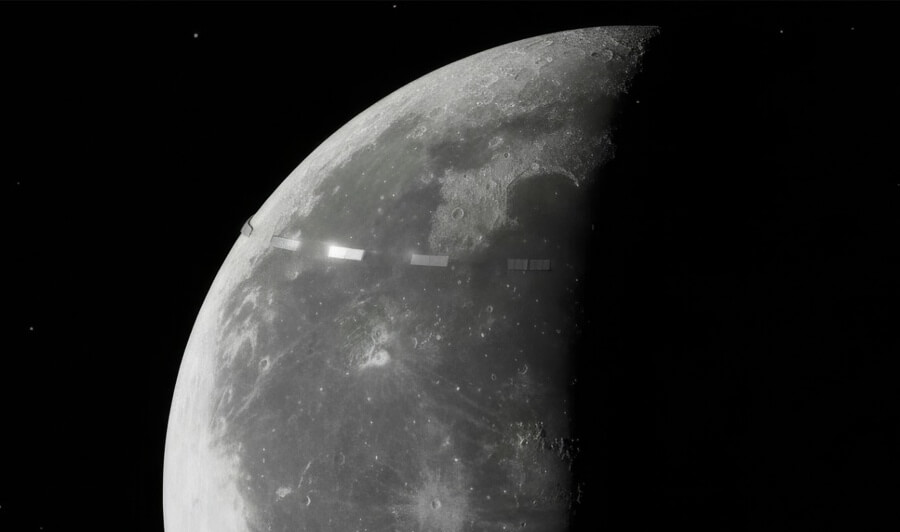
At 45 degrees latitude, the moon has a circumference of 7,700km. If we build 20 solar farms across the circumference, each one would be about 385 kilometers apart.
But we don't need to dream that big yet. If we want to decrease our lunar night duration — in terms of being starved of energy — by, let's say, just 10%, placing a single solar farm 700 kilometers away would be enough to increase the time we are generating energy.
Laying the cable becomes the main problem. Even if we use any of the other options as an energy source, laying cables will be a necessity, as not everything will be in the same place. Long-term, it seems inevitable that 24/7 solar power will be a big energy source on the Moon, among others.
Power Scales
Solar may be our primary energy source, but different scales of power demand different approaches. We broke this down into three scales, each with its own trade-offs and requirements:
- Kilowatt scale
- Megawatt scale
- Gigawatt scale
Kilowatt scale
Launch costs required
From $1M/kg and below
Cost per MW installed
From $58B
Feasible latitudes
All latitudes
Technology used
Integrated solar arrays
Vertical mounts
Flat mount
East-West mount
Kilowatt scale is the smallest possible system that could be deployed to the lunar surface to start generating energy. At this scale, the best solution is to build and launch 20-50kW integrated systems, these units come pre-assembled with the solar modules and all power electronics, ready to be deployed without any construction.
These integrated systems would have all the power electronics in a shielded and insulated enclosure, along with a small battery, enough to survive the lunar night by heating itself and the electronics.
For a 40 kWp integrated solar system, a 40 kWh battery is sufficient to sustain a continuous 50 W draw during the lunar night while maintaining a 50% safety margin. Additionally, the 50 W figure is conservative, as using modern MLI and aerogel at the bottom of the enclosure can save even more energy.
While kilowatt scale systems can be used anywhere on the Moon, we will focus on the high latitudes or the poles, which is currently where the first lunar bases are expected to be.
The poles of the Moon are extremely interesting mainly because of the presence of water ice. Water is essential for industry, humans, fuel production, and really almost anything.
At the poles, the sun never rises high into the sky; it remains near the horizon throughout the day. However, lunar night still exists like any other place on the Moon.
There is a lot of talk about zones with eternal or constant light at the lunar poles, located in very high places relative to their surroundings.
While they exist, they are extremely scarce.
If you add up all the very high edges where you can get near eternal light, they total between 1 to 5 square kilometers [10], these square kilometers are divided between many different locations, a lot of them no more than a few dozen meters in size.
What's more, climbing hundreds of meters up a steep slope to reach the thin edge of a crater to set up modules there, is a very precarious proposal.
While these places are promising for generating some base power, they won't be able to sustain large energy requirements.
Simulation of the Sun’s path on the Moon at latitude 74° N
Due to the low angle of the sun at the lunar poles, the most effective way to capture energy is to mount panels vertically. The Artemis program plans to utilize thin solar modules standing up to 20 meters tall to catch those horizontal rays. [11] [12] [13]
This is a good starting point, but it's impractical for generating considerable amounts of power. A 20-meter tower casts a massive shadow at the poles, so much so that the next row of vertical modules would need to be placed 170 to 700 meters away from each other [14] [15], this would require 20 to 140 times more surface to produce the same amount of power compared to a "traditional" solar farm with rows close to each other.
Needing 20 to 140 times more surface doesn't sound that bad, land on the Moon is free, but the terrain at the poles can be extremely rough. A location 400 meters away might be at a lower elevation due to a slope or crater, making it unusable. You also need to run cables between all the modules, adding even more challenges.
Solar energy at the poles is a good start, but not practical if you want large amounts of power.
Megawatt scale
Launch costs required
From $100,000/kg and below
Cost per MW installed
From $6B
Feasible latitudes
60° and below possible, 45° and below ideal
Technology used
Vertically tilted east-west mount
East-west mount
Flat mount
Building multi-megawatt-scale solar farms requires a shift away from the poles toward the equator. While this type of solar farm is feasible from 60° latitude and below, the ideal location is from 45° and below, where we can truly simplify construction and even lay the solar modules flat on the surface with a little preparation.
Avoiding vertical mounting structures allows us to save on construction and mass, placing the solar modules much closer to each other, further saving on mass and the extra components needed when the solar farm parts are too far away from each other.
While lunar gravity is around ⅙ of Earth's, and there are novel ideas on how to mount dozens or even hundreds of meters of modules vertically with relatively low structural mass, the best structure is still no structure, and there is no better way to achieve that than to leverage the lunar surface.
Solar energy has become one of the cheapest energy sources on Earth per watt because a solar farm is a very simple construction with highly standardized parts and designs, allowing high reliability and low overall costs. Combiner boxes go here, inverters go close by, medium voltage has its well-defined place, and so on.
To lower the cost per watt on the Moon, the strategy, which is really dictated by physics, will remain the same: lower mass, lower parts complexity, lower installation time, and increased reliability.
At the megawatt scale, we can adopt the approach used on Earth: treat each system component as modular, allowing us to build solar farms of different sizes without full integrated pre-assembly on Earth.
However, this will require:
- More machines (or robots).
- Light construction
First of all, these types of solar farms will still require heating and protection for all their power electronics. One way to achieve this is by creating "lunar vaults", which would be excavated holes on the regolith surface, allowing us to:
- Save weight on shielding and insulation, as regolith is an excellent insulator and offers a decent level of radiation protection.
- Use distributed electrical racks that don't need to be fully integrated or custom-built for each site, since components can be combined or separated based on system requirements.
- Limit nighttime energy use, as we only need to heat electronics contained inside the lunar vaults.
- Deploy megawatt-scale battery packs that can be buried or semi-buried using heavy robots or machinery.
Construction would still be avoided as much as possible, but with a few capabilities like hauling, surface grading, excavation, and a transport platform, much could be done to deploy MWs of power while also saving a lot of mass.
Gigawatt scale
Launch costs required
From $1000/kg and below
Cost per MW installed
From $300M
Feasible latitudes
45° and below possible, 30° and below ideal
Technology used
Flat mount
East-West mount
Earth like solar farms
One of the main advantages of the Moon is the resources found in the lunar regolith. The exact composition varies depending on location, but it typically includes:
- Silicon
- Oxygen
- Aluminum
- Iron
- Magnesium
- Calcium
- Hydrogen
- Helium
Among others.
Utilizing these in-situ resources, we can manufacture several key components directly on the lunar surface:
- Solar cells
- Frames and mount structures
- Conductors
- Radiators
- Radiation shielding
Manufacturing these components requires some trace materials that are not on the Moon; however, the quantities needed are small enough that sending them from Earth would be cheap enough.
At this stage, electronics and advanced components would still be brought from Earth, which will retain far more advanced manufacturing capabilities than the Moon.
Even with trace materials and electronics sourced from Earth, more than 90% of the mass of a solar farm would originate on the Moon, lowering logistics costs and complexity dramatically.
The Future Ahead
Between the several megawatts of solar power already working in space and our current battery energy density, we already have the means to energize the Moon. While the future looks bright, we need to pause for a second and revisit the two critical requirements mentioned for space exploration to inevitably take off.
In the near future and leveraging the Artemis program, we could deploy a few hundred kilowatts for a few billion dollars. Costly, but possible.
For the MW scale, we need SpaceX or others to step up and lower the launch cost considerably. At this scale and with a reasonable launch cost, it's possible to imagine a government project that could need a few megawatts, but not much more than that.
To truly scale to multi-MW or even reach the GW scale, we certainly need the "irresistible" part of this equation: for space to become very profitable outside observation and communications, or in our case, for the Moon to make money.
Just as rockets need to escape Earth's gravity to succeed, the space industry needs to escape the handcuffs of government funding, and be able to grow and exist mostly on its own.
It's clear that the variable at the heart of this is the launch cost. There is no shortage of companies working on technology for businesses on the Moon or Moon related ventures. From privately developed robots and rovers, to hotels on the Moon, resource harvesting, and more.
Let's light a candle for the companies working on launch. No pressure, you just have the world on your back.
Impossible
All of this sounds impossible, improbable, unrealistic, even stupid to most people.
And maybe it is, at least today. But don't be mistaken, you don't need general consensus to change things, just an inalienable truth that you believe beyond doubt.
- While the Wright brothers worked on their plane, The New York Times published an article stating it would take at least one million years for humanity to develop a flying machine.
- "Electric vehicles are a dead end", the opinion that almost every carmaker had 20 years ago along with the rest of the car industry.
- Alfred Wegener was ridiculed in 1915 when he proposed the idea of tectonic plates, an idea that would go on to become the accepted truth and taught in schools all over the world.
- "Artificial intelligence is 50 years away or more", but companies like Google and OpenAI believed otherwise.
- Robert Goddard, the father of modern rocketry, was mocked by The New York Times for claiming that rockets could work in a vacuum.
- "Solar energy is a toy for environmental aficionados", an idea very popular not that long ago. Today, solar energy is arguably the cheapest energy in the world, and growing rapidly.
- Executives at Arianespace, ULA, and government agencies are on record (for the deniers) dismissing rocket reusability as "unfeasible" and a "dead end" as late as 2014.
- People didn't believe that technologies like trains, cars, or radio waves would work, all of them were readily dismissed.
And countless other stories like this, big and small.
Of course, this is where the argument of confirmation bias is usually raised as a counterpoint. Just because some people did some weird improbable stuff, that doesn't mean this weird improbable stuff will happen.
We know about confirmation bias. We know that for every thing that works, there's thousands that didn't, that's fine.
The main reason the format of this text was converted from a whitepaper to a conversational piece is simple: it doesn't matter the in depth calculations we could present, how detailed the material properties and costs, or how thorough the analysis on the best ways to lay cables on the Moon, there would still be a majority of people who choose not to believe.
That's fine. Just as life found a way to flourish on almost every corner on Earth, humanity will continue this long tradition, gaze toward the stars and venture permanently into the cosmos.
References
- Space Launch Data. Aerospace Security, Center for Strategic and International Studies. spacedata.aei.org/space/launches.
- World Airlines Traffic and Capacity. Airlines for America. airlines.org/dataset/world-airlines-traffic-and-capacity.
- Starlink. 10 million active customers. x.com/Starlink/status/2022446814591615013.
- Elon Musk, Jeff Bezos space data centers. Business Insider. businessinsider.com/elon-musk-jeff-bezos-space-data-centers-scientists-ask-why-2026-4.
- Tech giants like Nvidia and Google eye space to power AI with orbital data centers. Carbon Credits. carboncredits.com/tech-giants-like-nvidia-and-google-eye-space-to-power-ai-with-orbital-data-centers.
- Thermal estimate for a 1 m³ insulated enclosure using MLI and aerogel. ChatGPT research. chatgpt.com/share/69d809cf-c4fc-8330-9294-f0bfe8ffaaff.
- ISS-based estimate for continuous power per person. ChatGPT research. chatgpt.com/share/69d81003-f098-8330-b387-b6eddf847bb8.
- Slyuta, E. N., Dudchenko, V. A. A temperature distribution model in the lunar soil at the polar regions. 54th Lunar and Planetary Science Conference 2023. hou.usra.edu/meetings/lpsc2023/pdf/2198.pdf.
- NASA. Multi-Mission Radioisotope Thermoelectric Generator (MMRTG) fact sheet. discovery.larc.nasa.gov/PDF_FILES/26_MMRTG_Fact_Sheet_update_5-7-19-Mission_Planner.pdf.
- Mazarico, E. et al. Illumination conditions of the lunar polar regions using LOLA topography. researchgate.net/publication/251730356_Illumination_conditions_of_the_lunar_polar_regions_using_LOLA_topography.
- NASA TechPort. Lunar Vertical Solar Array Technology. techport.nasa.gov/projects/116305.
- Blue Origin. Honeybee Robotics deploys LAMPS at NASA Johnson Space Center. blueorigin.com/news/honeybee-robotics-deploys-lamps-at-nasa-johnson-space-center.
- Astrobotic. Astrobotic developing XL solar array tech for lunar power infrastructure. astrobotic.com/astrobotic-developing-xl-solar-array-tech-for-lunar-power-infrastructure.
- Gemini sconversation about lunar shadow. gemini.google.com/share/77bd60a9c969.
- ChatGPT conversation about lunar shadow. chatgpt.com/share/69d81696-ae7c-8326-9589-494acee438b5.